
Project Value
US$677,723
Continuing the Fight to Eliminate Preventable Blindness in Sri Lanka
Vision for Jaffna: Continuing the Fight to Eliminate Preventable Blindness in Sri Lanka
This initiative builds upon two transformative Rotary-supported eye care projects that have already changed the future of ophthalmic care in Northern Sri Lanka:
- GG2576338 – Vision for Vavuniya: Restoring Sight, Reviving Lives
- GG1417133 – Supply of Medical Equipment to the Jaffna Teaching Hospital
Together, these projects demonstrated what becomes possible when Rotary, healthcare professionals, international partners and communities unite around one simple belief:
No person should lose their sight because treatment or equipment was unavailable.
Now, the next phase of this journey aims to further strengthen the Eye Unit at Teaching Hospital Jaffna under the leadership of Dr M. Malaravan, creating a regional centre capable of addressing the growing cataract crisis across Northern Sri Lanka.
Building on Proven Rotary Impact
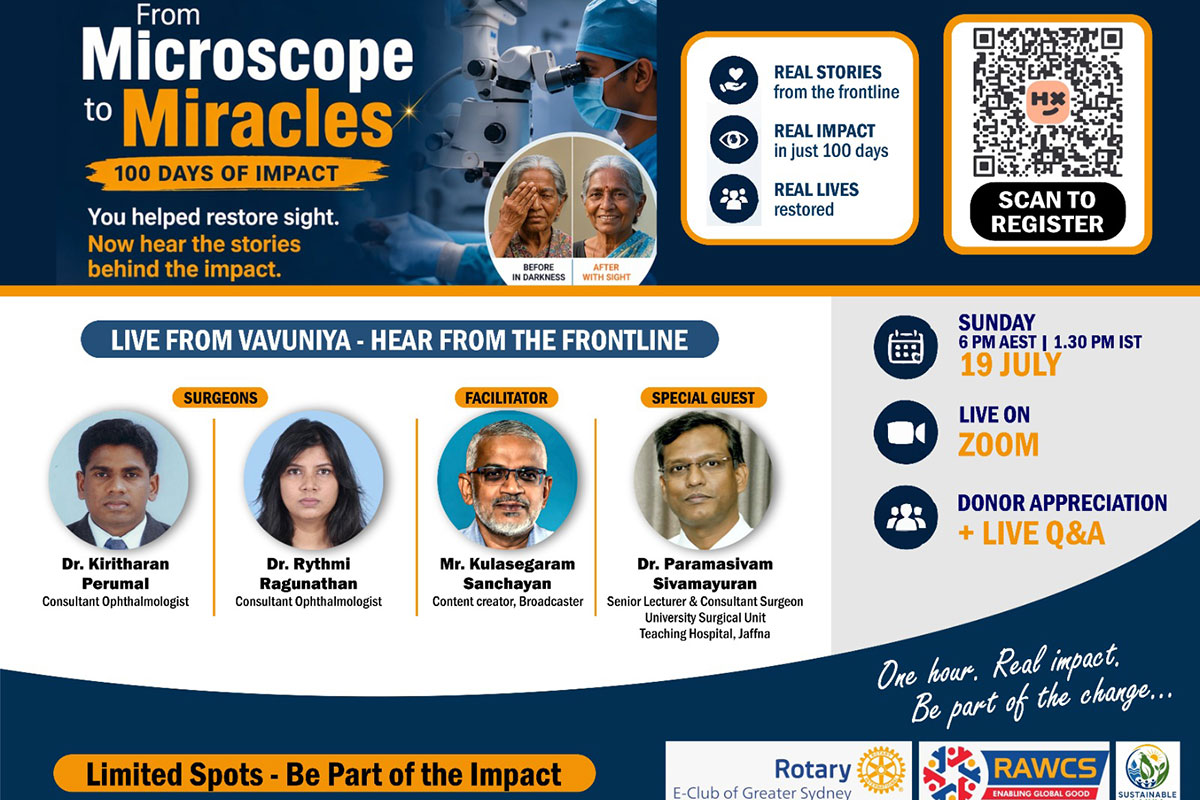
The successful implementation of GG2576338 – Vision for Vavuniya delivered a state-of-the-art ophthalmic operating microscope to District General Hospital Vavuniya, dramatically improving cataract surgery capability and restoring sight to vulnerable patients who previously faced long delays and limited access to specialised care.
Likewise, GG1417133 – Supply of Medical Equipment to the Jaffna Teaching Hospital strengthened critical medical infrastructure at Teaching Hospital Jaffna and reinforced Rotary’s long-term commitment to rebuilding healthcare capacity in post-conflict Northern Sri Lanka.
These projects were not isolated interventions.
They became part of a larger movement toward sustainable, equitable healthcare access — particularly for elderly and underserved communities affected by poverty, distance, and years of healthcare strain.
Why This Next Step Matters
Cataract remains the leading cause of blindness in Sri Lanka, responsible for nearly 67% of blindness cases nationwide.
Despite Sri Lanka’s strong public healthcare system, the country still faces:
- An estimated 1.5 million cataract backlog cases
- Over 100,000 people currently blind due to cataracts
- Severe shortages in surgical throughput capacity
- Regional disparities affecting the Northern Province
- Growing demand from an ageing population
Many patients wait months — sometimes years — for surgery.
For some, the delay means permanent vision deterioration.
For others, it means losing independence, employment, mobility, and dignity.
The challenge is no longer simply awareness.
It is now a question of capacity.
The Next Phase: Capacity Building for Teaching Hospital Jaffna
This proposed project seeks to significantly enhance the ophthalmic capabilities of Teaching Hospital Jaffna through the provision of advanced cataract surgical and diagnostic equipment.
Proposed Equipment
- Centurion Silver Phaco System with accessories
- Carl Zeiss OPMI Lumera 700 Operating Microscope
- IOL Master 700 Non-Contact Biometry System
- Specular Microscope SP-1P
- Contact Ocular Biometry System
- Slit Lamps
- Rebound Tonometers
- A/B Scan with Pachymetry
- Cataract Surgery Instrument Sets
Impact Snapshot
USD 677,724 → Advanced ophthalmic surgical & diagnostic systems → Expanded cataract surgery capacity and reduced preventable blindness across Northern Sri Lanka
Beyond Surgery — Restoring Lives
This project is not simply about machines.
It is about what happens after sight is restored.
A grandmother can once again see her grandchildren clearly.
An elderly farmer can safely walk independently.
A patient can return to work instead of depending on family members.
A hospital can perform more surgeries with greater precision and efficiency.
And perhaps most importantly:
A preventable condition no longer has to become a lifelong disability.
A Long-Term Vision for Northern Sri Lanka
By building upon the success of earlier Rotary Global Grants, this initiative represents a strategic continuation of Sustainable Lanka’s commitment to healthcare equity and sustainable medical infrastructure.
The goal is clear:
- Reduce the cataract backlog
- Increase surgical throughput
- Improve diagnostic accuracy
- Strengthen regional ophthalmic capacity
- Eliminate preventable blindness wherever possible
This is continuous improvement in action.
Not a one-off donation.
Not temporary relief.
But a sustained investment in restoring sight, dignity and hope for generations to come.